You Don't Need AI. You Need Software.
Most 'AI use cases' SME owners describe are actually just scripts. Here's how to think about building systems when you don't have an enterprise IT budget.
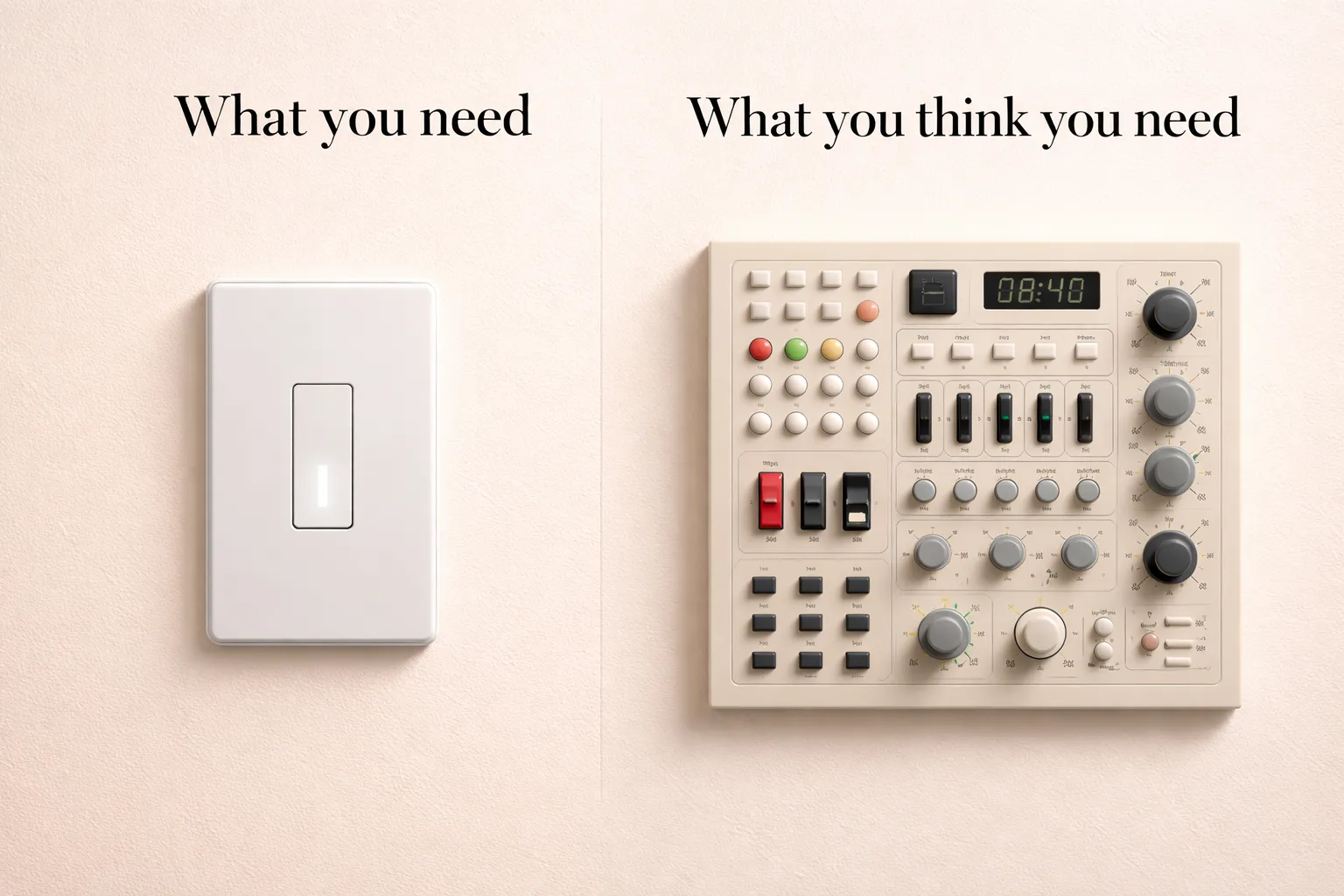
Disclaimer: This post is not about AI. And I’m defining “software” very loosely.
Most SME owners—technical or not—agree that AI is impressive. Fewer can describe a realistic application for their business. And of those, only a small fraction can actually execute on the idea.
Here’s what I find interesting: most “AI use cases” I hear aren’t really AI use cases. They’re automation. Sometimes just a script. Often an Excel formula with a trigger attached.
Things like:
- “AI replacing manual work” → “Wish AI would fetch X and enter it into Y”
- “AI alerts” → “Wish AI would monitor X and notify me when Y happens”
- “AI quality control” → “Wish AI would flag when someone does X incorrectly”
- “AI reporting” → “Wish this report ran faster and included Y”
- “AI project management” → “Wish AI could assign tasks and send status updates”
If you work at a large company, you’ve probably noticed: none of this is new. Internal IT teams have been building exactly this for decades—long before ChatGPT entered the conversation.
How Do You Build This Without an IT Department?
As an SME, you don’t have the budget for a dedicated technical team. So you need a different approach.
Consider the difference between Nike’s warehouse and Gymshark’s warehouse.
When Gymshark was starting out, they didn’t look at Nike’s global distribution network and conclude “we can’t build that, so we won’t have logistics.” Obviously not—they built something appropriate for their scale.
But here’s the less obvious part: if you handed early-stage Gymshark the keys to Nike’s entire warehouse infrastructure for free, it would actually hurt them. The operational complexity, the staffing requirements, the maintenance overhead—all designed for a volume they don’t have. It would be a liability, not an asset.
The same logic applies to software.
Being small doesn’t mean you shouldn’t have systems. It means you can use dramatically simpler solutions—because your problems are simpler too.
Consider: most SMEs won’t accumulate more than a million rows of data even if they tracked everything they’d want to track for five years. Large enterprises might process that volume in a single afternoon.
Your software doesn’t need to:
You’re not building enterprise software. You’re building a small, functional warehouse.
So What Do You Actually Need?
Three things.
That’s the entire framework.
The database is your source of truth. The interfaces let people interact with it cleanly. The automations ensure things happen based on what’s recorded.
You don’t need machine learning. You don’t need a data science function. You don’t need to hire engineers.
You need structured data, connected to tools that act on it automatically.
That’s software. And it’s been solving these exact problems since long before “AI” became a marketing term.
For a concrete example of this approach—no AI involved—see how we built route planning for a small pet shop. Pure software, real business results.
Written by
Eduardo Chavez
Director, Costanera